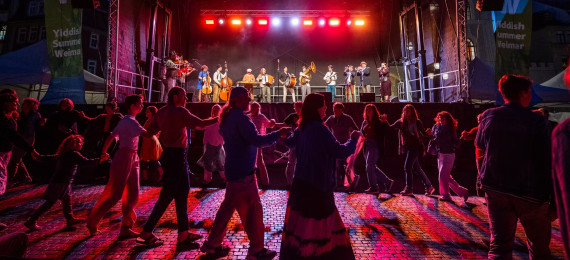
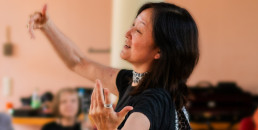
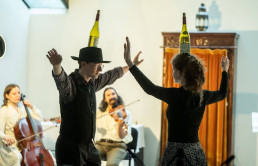
A: Hi Sayumi! You’ve been working for Yiddish Summer Weimar and the OMA for many years, and we’d like the readers of this newsletter to get to know you a little better. So let’s start at the beginning. What’s your name and where are you from? S: My name is Sayumi Yoshida, and I was born in Mito City, Japan. Mito is the capital of Ibaraki Prefecture and is part of the Greater Tokyo Area, about 90 kilometers from central Tokyo. A: Mito City! What’s special about that place? S: Mito is famous for Kairakuen, one of Japan’s three great gardens, which features more than 3,000 plum trees. It’s gorgeous in the springtime! There are six schools located on the grounds of the former Mito Castle, and I used to take the school bus every day to the elementary school there, passing through the castle gate known as Otemon. A: So did you stay in Mito until you came to Berlin? S: No, after graduating from high school, I moved to Tokyo, studied graphic design at a design college, and began working at a design studio after graduation. That studio had many European clients, particularly in Germany, so I was given the opportunity to travel to Europe to broaden my horizons, and I visited West Germany for the first time in 1984. A: Wow! What was your first feeling when you arrived in Berlin? S: When I arrived at Berlin’s Zoo Station, I felt, “I’m free here; I can finally breathe.” The sense of suffocation I had felt in my daily life in Japan was gone. I liked it so much that I wanted to live there, but I wondered if it was just because it was my first visit―would I feel the same way if I came back? To find out, I visited Berlin again in 1986. I also went to London that time, but I became convinced that Berlin was the only place for me, so I moved there in 1987. A: 1987 is the same year I came to Berlin… S: Yes, in fact, I met you on my second day there in our German class at the Goethe-Institut! (What a coincidence!) A: Looking back 39 years ago, it certainly seems like either coincidence or fate… So what did you do in Berlin? S: After studying German, I enrolled in the Visual Communication department at the HdK (Hochschule of Arts, now the University of Arts) where I studied graphic design, stage design, and installation art. After graduating, I worked as an installation artist, participating in exhibitions and performances. Once the internet became a thing I started working in web design and as a designer in both print and digital media. A: This all seems a long way away from Yiddish Culture! How did you get involved with that? S: In 1989 I took part in my first Yiddish dance workshop during a Brave Old World tour, Michael Alpert was my teacher. A: Aha! So Yiddish dance is what got you interested. But then… S: Then, in 2010 I did the graphic design for Winter Edition and after that I created the corporate design for both Yiddish Summer Weimar and the OMA, including web and print materials. A: That also seems pretty far away from both Yiddish dance and the kind of design you were doing in Tokyo and in the art scene in Berlin. What did you find interesting about designing for YSW? S: Since YSW has a different theme every year or every few years, it’s a challenge to find a visual concept that both fits the theme and has continuity with YSW. I generally work on this collaboratively with Alan Bern – do you know him? A: I’ve heard about him… So what’s it like to work on the topic? S: Depending on what it is, it can be quite difficult and time-consuming, but every year is a new challenge and ultimately very rewarding. It’s also interesting that you can see the history (evolution) of YSW at a glance just by looking at the T-shirt designs. A: And what happened to your initial interest in Yiddish dance? S: Actually, I’ve been dancing Yiddish dance continuously since I first learned it in 1989, but at first it was just for pleasure. Around 2000, I started taking an interest in the finer details, especially the style. In the last decade, studying with Zev Feldman has been very important to me. I also became interested in other traditional dances and began learning flamenco and tarantella. I focused on tarantella because I was able to improvise right away. To my surprise, I became hooked on the depth and complexity of various traditional performing arts. A: And now you regularly teach the dance mini-workshop during the YSW Festival Week… do you teach other places, too? S: Yes, I also lead Tantshoyz sessions in Germany and teach workshops in Germany, the UK, Italy and Japan. A: That’s a fascinating variety of interactions with Yiddish culture. Thank you for sharing that with us! S: You’re welcome! A: See you at Yiddish Summer Weimar this year? S: Mochi ron! (Of course!) |